


MONSTRANCES
Carry Christ to the World Through Our Catholic Monstrance Mission

Every community deserves the opportunity to encounter Jesus in the Eucharist.
Yet thousands of parishes, mission churches, prisons, schools, and remote communities simply do not have a monstrance to expose the Blessed Sacrament for Eucharistic Adoration.
Through Catholic World Mission, faithful supporters like you are changing that.
This Corpus Christi season, you can help carry Christ to places where His visible
Eucharistic presence brings hope, healing, peace, and renewed faith.

The Power of One Monstrance
On the Feast of Corpus Christi, children at Mano Amiga School in Monterrey, Mexico, experienced Eucharistic Adoration for the very first time.
A monstrance provided through Catholic World Mission had just arrived.
Before anyone explained what to do, the children reached toward Jesus.
They recognized their Savior.
Moments like these remind us that Christ draws hearts to Himself.

HOW YOUR CATHOLIC MONSTRANCE MISSION CHANGES LIVES
CAMEROON
For years, Archbishop Andrew Nkea Fuanya prayed for Perpetual Adoration in a region suffering from violence and poverty.
Chapels were built.
The faithful were ready.
Then, through God's providence and your generosity, two Catholic World Mission monstrances arrived just as Pope Leo XIV visited Cameroon.
A dream became reality.
Hope found a home.
COLOMBIA
Father Jhonis travels by speedboat through remote islands to celebrate Mass and share the Gospel.
Now he carries something even more extraordinary.
A monstrance.
Because of your generosity, communities unable to travel can now spend time in the presence of Christ through Eucharistic Adoration.
LOUISIANA
Inside the Louisiana State Penitentiary at Angola, many inmates will never leave prison.
But Christ entered.
Thanks to Catholic World Mission supporters, a monstrance now allows incarcerated men to encounter the mercy and healing of Jesus through Eucharistic Adoration. No heart is beyond His reach
Why the Catholic Monstrance Mission Matters
The Eucharist is the source and summit of the Christian life.
A monstrance does not bring Christ where He was absent
It makes His Real Presence visible so the faithful can adore Him, pray before Him, and encounter His mercy in a profound way.
Every monstrance becomes a lasting gift that serves generations of Catholics.
The Need Is Greater Than Ever


The Catholic Church continues to grow throughout Africa, Asia, and Latin America.
-
More than 1.4 billion Catholics live around the world.
-
Nearly 70% of Catholics now live outside Europe and North America, with the Church growing most rapidly in the Global South.
-
Thousands of mission parishes still lack basic liturgical resources needed for Eucharistic Adoration and evangelization.
These communities are rich in faith,
but often poor in resources.
Providing a monstrance allows countless people to spend time before Jesus for years to come.
(Statistics based on Vatican and global Catholic demographic reports.
Today, your gift will provide monstrances to mission churches, schools, prisons, and remote communities around the world, creating places where generations can come before Jesus in Eucharistic Adoration.
Your Gift Can Carry Christ!


Delivering Monstrances Around the World

Catholic World Mission strongly emphasizes evangelistic revival and spiritual development in its core values. Our latest endeavor involves providing underprivileged parishes and communities with monstrances to foster increased devotion to the life-giving power of the Eucharist.
“The love of God and neighbor, the greatest commandment, is expressed in, and the fruit of Eucharistic worship.”
– St. John Paul II
Whats is Adoration?

Eucharistic Adoration is a Catholic tradition in which we get to be in the presence of the exposed Blessed Sacrament. The Body of Christ is held in a monstrance and stationed in a designated space, usually the altar or chapel, which allows us to have personal, tranquil, and uninterrupted time with Jesus. A consecrated host, one that has been transformed at Mass to the actual Body of Christ, is removed from the tabernacle. While the tabernacle does hold the consecrated hosts, is available for prayer, and given reverence, the Eucharist is still covered, concealed, and usually locked inside. For Eucharistic Adoration, the host is placed in a monstrance that contains a glass compartment (called a luna) and exposes the Eucharist before all. The exposition of the Blessed Sacrament proves to be the key and most important factor of Eucharistic Adoration. If the parish chooses to only have particular hours for Eucharistic Adoration, an ordained minister will repose the Blessed Sacrament and place it back in the tabernacle. The exposition of the Blessed Sacrament serves as an extension of the adoration and praise of the Body and Blood of Christ during the Mass. Eucharistic Adoration allows us to acknowledge the strength and almighty power of our Lord and Savior. During this time of reverence, visitors may pray, recite the rosary, read scripture, offer intentions, or simply sit in the presence of the Lord. Open to anyone, Eucharistic Adoration also assigns the visiting adorers the responsibility of being a guardian to the Blessed Sacrament. This silent period of time with Jesus gives many people the blessing of internal peace, greater hunger for Communion with God, and deepened assurance in His power and presence.
When did Adoration Start?

The origins of Eucharistic Adoration can be dated back to the time of Jesus’s first apostles. These evangelists strongly emphasized the physical presence of Christ in the Eucharist and its role in being a continuation of Jesus’s saving mission. Influenced by this faith, early hermits would conceal and often preserve the Eucharist in their caves for safekeeping. They would also carry the Eucharist on their person when traveling. By the Fourth Century, the Eucharist was commonly reserved in monasteries and convents and served the primary purpose of reaching the sick and dying. The keeping of the Blessed Sacrament in religious houses became very guarded, often under lock and key. The 11th century brought extremely controversial voices that rejected and criticized the physical transformation of bread and wine into the Body and Blood of Christ. Pope Gregory VII, defending against this heresy, clarified the Church’s teaching on the Eucharist: Jesus is truly and actually present in the Eucharist. This clarification created various gateways for visits, viewings, and adoration of the Blessed Sacrament. This “eucharistic renaissance” brought about a more open and available worship of the Blessed Sacrament. Since then, the ability to adore and be before the Eucharist has developed greatly and continues to move the hearts of countless individuals and communities.
Why should I do go to Adoration?

By attending Eucharistic Adoration, we are accepting an invitation from Jesus to grow closer to Him. With the presence of the exposed and physical being of Christ, God reveals his tenderness to us in the silence. By allowing God into our hearts, He gives strength and hope to those who wander or are lost. Eucharistic Adoration blesses one with a temporary escape from the secular world to bring our struggles before God. Away from noise and distractions, adoration opens an opportunity for healing, guidance, enlightenment, forgiveness, and peace.
Who can Participate?

Anyone is welcome to visit and pray with the Blessed Sacrament. God makes his grace available to all his children. From individuals to groups to entire parishes, Eucharistic Adoration is offered to all for petitions and thanksgiving.
Does Adoration Benefit the Community?
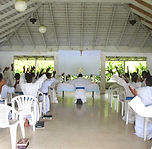
It does! The tradition of Eucharistic Adoration also brings an abundance of blessings for the parish. Whether attending on a whim, on your own schedule or signing up for a specific guardian time, attending adoration increases your involvement in parish life. Exposition of the Blessed Sacrament offers a place for the community to come together in deep prayer and adoration. God pours out his love and support to parishes in need. Parishes that become anchored in Christ in this way are able to withstand any challenge, change, or shortcoming. The Eucharist is also a sign of personal communion with God. The more we develop this spiritual relationship on a personal, individual level, the better we get at developing an authentic love of neighbor, which strengthens the parish family.
About Eucharistic Miracles

St. John Fisher (1469-1535) and St. Thomas More (1478-1535) were strengthened in life and prepared for martyrdom by fervent adoration of the Blessed Sacrament. In one of More’s prayers, published after his death, we read, “O sweet Saviour Christ, by the diverse torments of Thy most bitter Passion, take from me, good Lord, this lukewarm fashion or rather key-cold meditation, and this dullness in praying to Thee. And give me Thy grace to long for Thy Holy Sacraments, and especially to rejoice in the Presence of Thy Blessed Body, sweet Saviour Christ, in the Holy Sacrament of the Altar, and duly to thank Thee for Thy gracious visitation therewith.”

St. Margaret Mary Alacoque (1647-1680), a Visitation nun, found that the Blessed Sacrament gave her the strength she needed to endure what witnesses at her beatification process declared were “contempt, contradictions, rebukes, insults, reproaches, without complaining, and praying for those by whom she was ill-treated.”

On August 18, 1996, Father Alejandro Pezet was saying an evening Mass at a Catholic church in central Buenos Aires. Upon finishing distributing communion, a woman came forward and informed him that a discarded host had been seen on a candleholder in the back. Unable to consume the host, Father Pezet placed the Blessed Sacrament in a vessel of water in the tabernacle to allow it to dissolve. The following Monday, Father Pezet was astonished to find that the host had transformed into a significantly larger and bloody substance. Kept in secret and rejecting decomposition, the host was under lock for a few years.
Cardinal Bergoglio, now Pope Francis, had the substance scientifically analyzed by various specialists who determined that the mysterious substance came from an actual piece of human flesh. More specifically, it was announced to be a part of the left cardiac ventricle, a muscle responsible for pumping blood to the rest of the body. Furthermore, scientists concluded that due to an inflamed condition and an excess amount of white blood cells, the heart must have been alive when the sample was taken and had undergone severe amounts of stress.


Your Support Creates Lasting Impact
Your generous donations to Catholic World Mission have a direct and meaningful impact on the lives of those in need. By contributing to our cause, you are helping us meet basic needs and share the love of Christ with communities worldwide. We provide regular updates through photographs and videos, allowing you to witness the immediate difference your donation makes. We encourage you to support our mission and donate to Catholic World Mission today.